 By
·
8 minute read
Complexity doesn't always look like a problem. Sometimes it looks like a team working really hard.
The business is growing.
More clients. More employees. More projects. More technology.
And somehow, everything is getting harder.
➕ A client request that used to take one conversation now requires three emails, two approvals, and a meeting.
➕ Employees spend more time tracking down information than acting on it.
➕ Managers need regular updates just to understand what's happening.
➕ And the people who know how everything works are constantly being pulled into conversations to help everyone else figure it out.
The work is getting done.
But it's taking more people, more coordination, and more effort than it should.
That's the hidden operating cost of complexity.
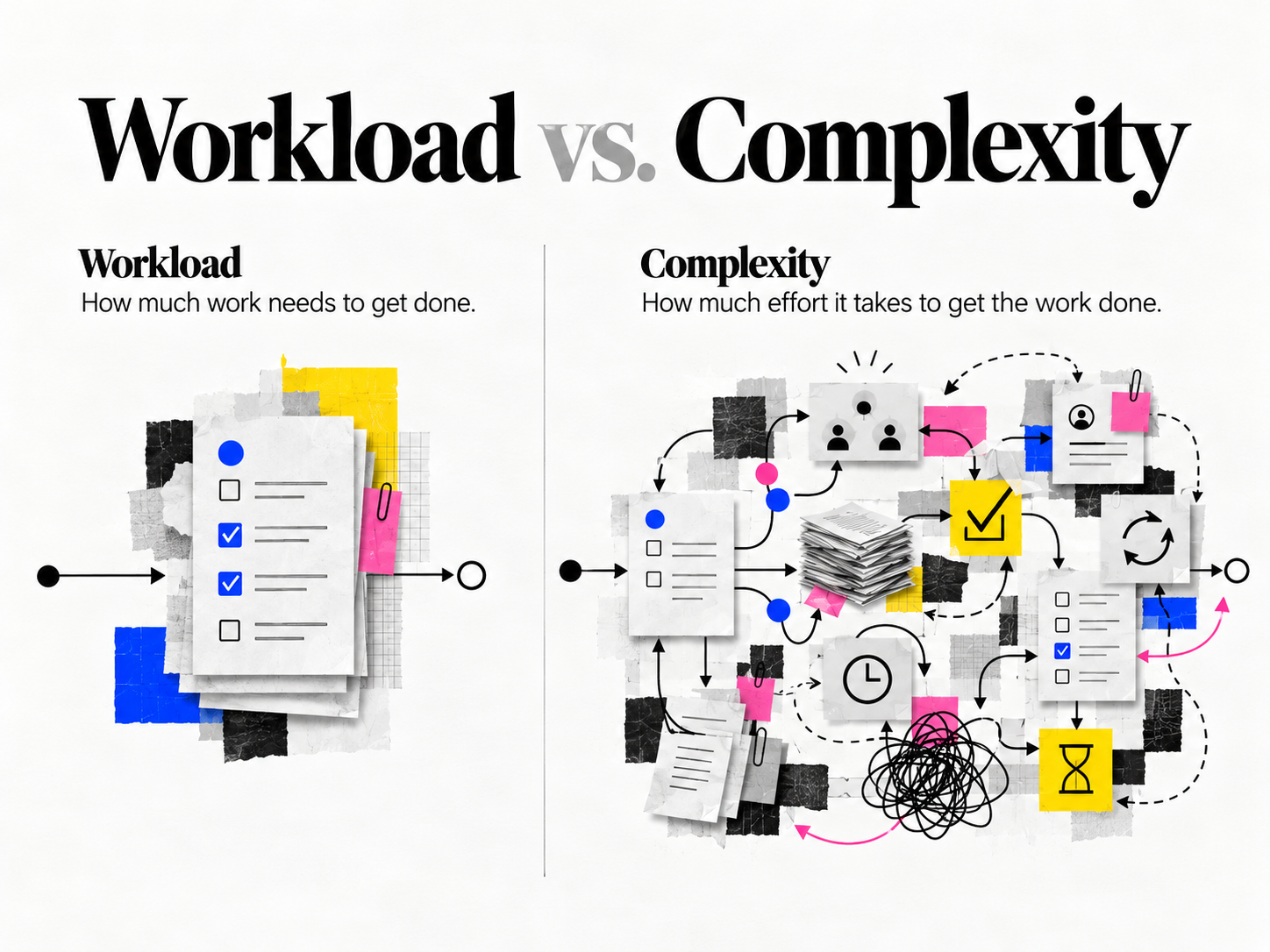
Complexity and workload are not the same thing.
When teams are overwhelmed, the natural assumption is that they have too much work.
Sometimes that's true.
But there's an important distinction.
Workload asks: How much work needs to get done?
Complexity asks: How much effort does it take to get that work done?
And those are two very different problems.
→ You can have a growing sales team, yet closing a deal still requires someone to manually reconcile information across three systems.
→ You can hire additional project managers, yet everyone continues attending status meetings because nobody trusts the project data.
→ You can expand your customer support team, yet resolving a simple request still requires employees to track down the right person to approve it.
In each case, the organization may have enough people to handle the actual work.
What it doesn't have is an efficient way for that work to happen.
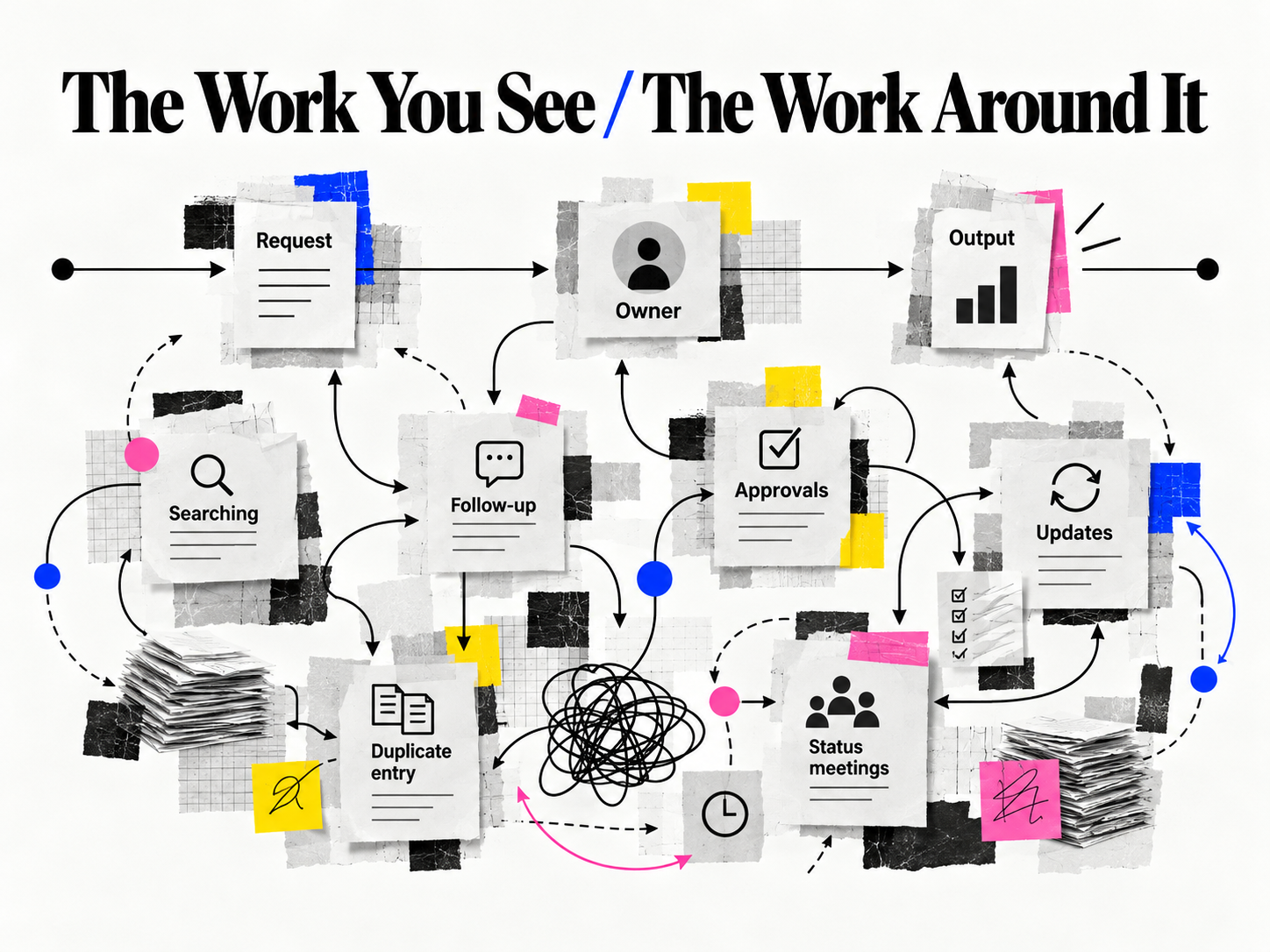
The work you see. And the work happening around it.
Consider something as simple as onboarding a new client.
On paper, the process looks straightforward.
- The deal closes.
- The client is introduced.
- The team begins work.
But behind the scenes?
- Sales emails the project manager with the details.
- The project manager asks for information that's missing.
- Someone creates a project in another system.
- Operations copies information into a spreadsheet.
- A manager reviews the scope because nobody is sure what was promised.
- The account manager sends another email to confirm the timeline.
- Everyone attends a kickoff meeting to get aligned.
- And someone still has to follow up afterward to make sure everyone knows what they're responsible for.
None of these activities may seem especially expensive on their own. But across hundreds of clients, projects, requests, and decisions, they add up. The organization isn't just paying for the work. It's paying for all the work required to coordinate the work.
And that cost rarely appears as its own line item on a financial statement.
How to Find and Reduce the Hidden Cost of Complexity
Not all complexity is unnecessary.
As organizations grow, they naturally need more coordination, specialized roles, controls, and structure. The goal isn't to eliminate every step or simplify everything at the expense of quality. It's to identify where complexity is actually creating value and where it's simply consuming time, resources, and attention.
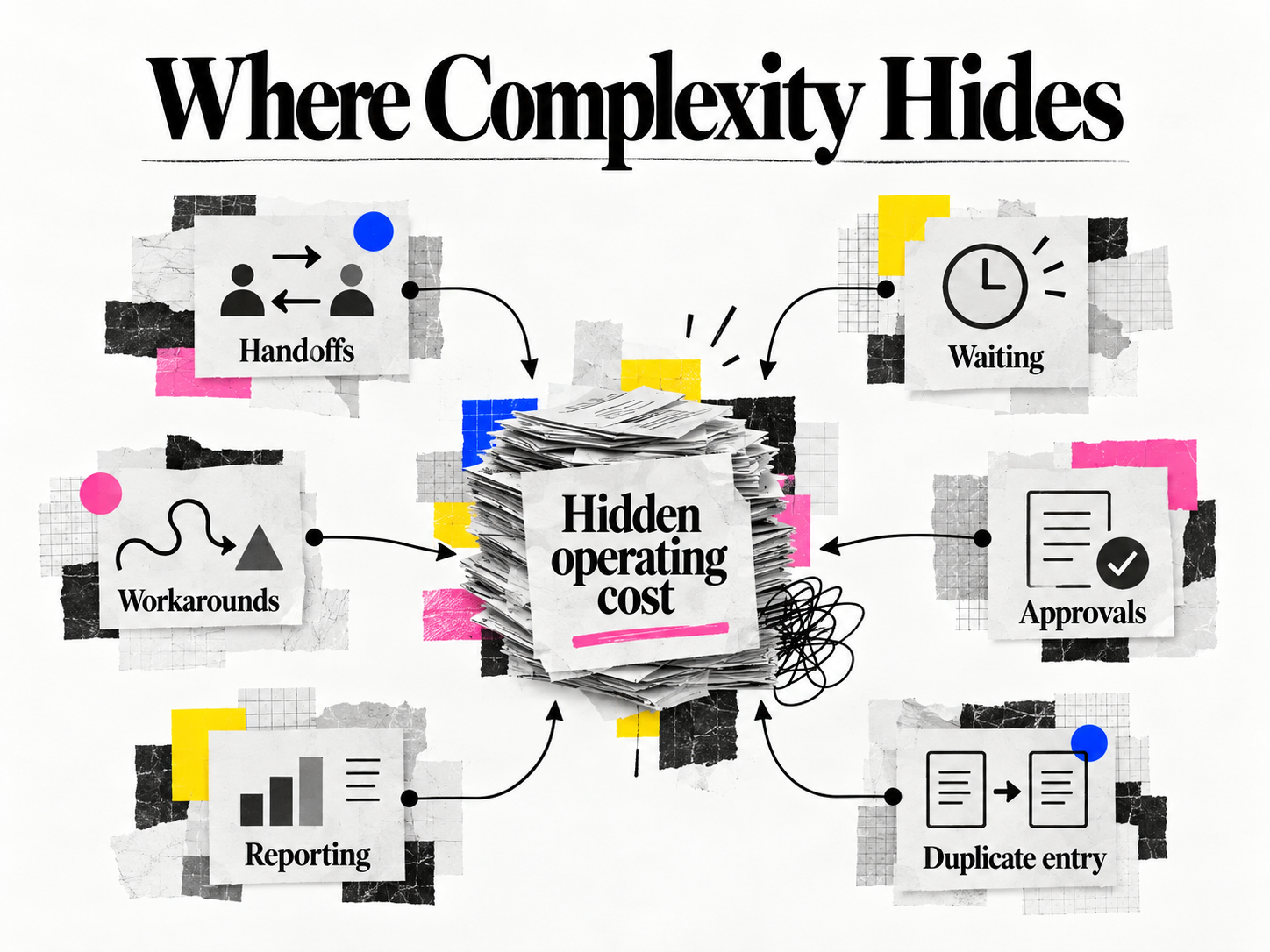
Here are the 7 places to start looking.
01
Follow the work, not the organizational chart.
When organizations want to improve operations, they often start by looking at departments.
→ Sales has its process.
→ Operations has its process.
→ Finance has its process.
→ Customer service has its process.
And each process might work reasonably well on its own.
The problems often happen between them.
Start by choosing one common activity and following it from beginning to end.
It might be:
- Onboarding a new client.
- Creating and approving a proposal.
- Processing a customer request.
- Launching a new project.
- Resolving a billing issue.
Walk through what actually happens, not just what the documented process says should happen.
- Where does the work begin?
- Who touches it?
- What information is required?
- Where does it go next?
- When does someone have to stop and wait?
- What happens when something doesn't go according to plan?
You may discover that each department has optimized its own part of the process, but nobody has designed how the entire process should work together.
A process can be efficient for one team and inefficient for the organization.
That's why you have to follow the work across the business, not just within individual departments.
02
Look for the work happening around the work.
Most organizations can tell you how many projects they completed, deals they closed, or tickets they resolved.
What they often can't tell you is how much time employees spent simply coordinating those activities.
Think about how often people:
- Ask for status updates.
- Search for information.
- Follow up on unanswered requests.
- Clarify who's responsible for something.
- Reconcile conflicting information.
- Prepare updates for meetings.
- Remind someone about a deadline.
These activities may be necessary occasionally. But when they become part of everyone's daily routine, they represent a significant operating cost.
Consider the employee who spends fifteen minutes every morning figuring out what needs their attention. That doesn't sound like much.
But if ten employees are doing the same thing every day, that's 12.5 hours each week spent just getting organized. And that's before anyone begins the actual work.
The question isn't whether employees are busy. It's how much of their time is spent moving work forward versus making the work possible.
Look closely at the second category.
That's often where the biggest opportunities are hiding.
03
Find where work is being done more than once.
Duplicate effort doesn't always mean two people are performing the exact same task.
➕ Sometimes it's the same information being entered in different places.
➕ Sometimes it's the same question being answered multiple times.
➕ Sometimes it's a report being recreated because nobody trusts the existing one.
For example:
→ A sales team maintains opportunity information in the CRM.
→ Finance keeps a separate spreadsheet to forecast revenue.
→ Leadership requests a weekly report to reconcile the two.
→ Now three different activities exist to maintain and interpret essentially the same information.
→ And every time something changes, there's a possibility that one version becomes outdated.
The problem isn't necessarily that the organization uses multiple systems. It's that information and effort are being duplicated without creating additional value.
Look for places where employees regularly say:
- "I already entered that."
- "Didn't we discuss this last week?"
- "Let me update my spreadsheet first."
- "I need to check which version is correct."
Those are signals worth investigating.
Ask whether the information needs to exist in multiple places, whether systems can share it, and whether everyone agrees on which version is authoritative. Sometimes a simple change in ownership or process eliminates hours of unnecessary work.
04
Identify where decisions get stuck.
Not all operating costs come from tasks.
Some come from waiting.
➕ A proposal is ready, but nobody knows who can approve the pricing.
➕ A client request needs attention, but it's unclear which department owns it.
➕ A project is delayed because two managers disagree on its priority.
Employees aren't necessarily doing anything wrong. They're waiting for the organization to tell them what to do. And while one decision sits unresolved, several other activities may be waiting behind it.
Decision-making is part of the operating system.
If every exception requires a meeting, every approval travels through the same manager, or every priority conflict needs leadership intervention, the organization has created a bottleneck.
Start asking:
- Who has the authority to make this decision?
- What information do they need?
- When does an issue actually need to be escalated?
- What decisions could be made without additional approval?
- Are people waiting because the decision is difficult or because ownership is unclear?
The goal isn't to remove oversight where it's needed. It's to make routine decisions easier and ensure exceptions reach the right people quickly. A process isn't efficient if the work moves quickly but every decision gets stuck.
05
Put a cost on the friction.
This is where complexity becomes easier to recognize as a business problem rather than just an operational inconvenience.
Organizations often measure the cost of technology, employees, and projects. But they don't always measure the cost of the processes connecting them.
Start by looking at three things.
1. Time spent
-
How much time are employees spending on duplicate entry, unnecessary meetings, manual reporting, follow-ups, and searching for information?
Even a rough estimate can reveal how much capacity is being consumed.
2. Delays created
- How long does work sit waiting for information, approvals, or handoffs?
- Does the delay affect project timelines, customer responsiveness, or the organization's ability to generate revenue?
3. Errors and rework
- How often does information need to be corrected?
- How many activities have to be repeated because instructions were unclear, ownership changed, or the wrong information was used?
- And what does correcting those mistakes require?
The real cost of complexity is rarely one large expense. It's the accumulation of small inefficiencies repeated across the organization.
Not every lost minute translates directly into recoverable savings. But the exercise reveals where capacity is being consumed and what the business might gain by improving the process.
That might mean serving more clients without adding headcount.
It might mean reducing project delays.
It might mean giving managers more time to lead instead of chasing information.
Or it might mean employees can finally focus on the work they were hired to do.
The goal is to understand not only what complexity costs, but what it prevents the organization from accomplishing.
06
Simplify the process before adding more technology.
This is an important one.
Organizations often respond to operational complexity by introducing something new.
➕ Another platform.
➕ Another workflow.
➕ Another dashboard.
➕ Another approval process.
➕ Another automation.
Sometimes that's exactly what's needed.
But sometimes the new solution is simply being added on top of everything that already exists.
Now employees have another place to enter information, another notification to monitor, and another process to remember.
The organization may have invested in improvement while actually increasing complexity.
Before adding something new, ask:
- What can we remove?
- Does every field need to be collected?
- Does every approval need to happen?
- Does every meeting serve a purpose?
- Does the same information need to live in multiple places?
- Can several variations of a process become one standard approach?
Then ask what can be consolidated, clarified, or automated.
Technology should reduce the effort required to operate the business. Not create more of it.
Don't automate a process simply because it exists. First make sure the process should exist in the first place.
07
Make simplicity an ongoing operating responsibility.
Here's the challenge.
Even after you've simplified a process, complexity can slowly return.
➕ A new client requires a slightly different approach.
➕ Someone adds another approval after a mistake.
➕ A department creates a spreadsheet to track something the system doesn't show.
➕ A new manager introduces a report.
➕ A team builds a workaround rather than addressing the underlying problem.
Each individual decision may seem reasonable.
But nobody is looking at what happens when all those decisions accumulate. And eventually, the organization is right back where it started.
Complexity grows when no one is responsible for managing it.
That doesn't mean every change needs to go through one person or committee. It means establishing a practical way to evaluate how the organization operates.
- When a new process is introduced, consider what it replaces.
- When a system is added, clarify what information it owns.
- When employees create workarounds, understand why.
- When a process becomes more complicated, ask whether the added complexity creates enough value to justify it.
- And when something no longer serves a purpose, retire it.
Build regular process reviews into how the organization operates.
- Ask employees where work is getting harder.
- Review activities that consistently require unnecessary coordination.
- Look for recurring exceptions, delays, and manual effort.
- Assign someone responsibility for evaluating and addressing what you find.
Simplification shouldn't be a one-time cleanup project. It should be part of how the business evolves.
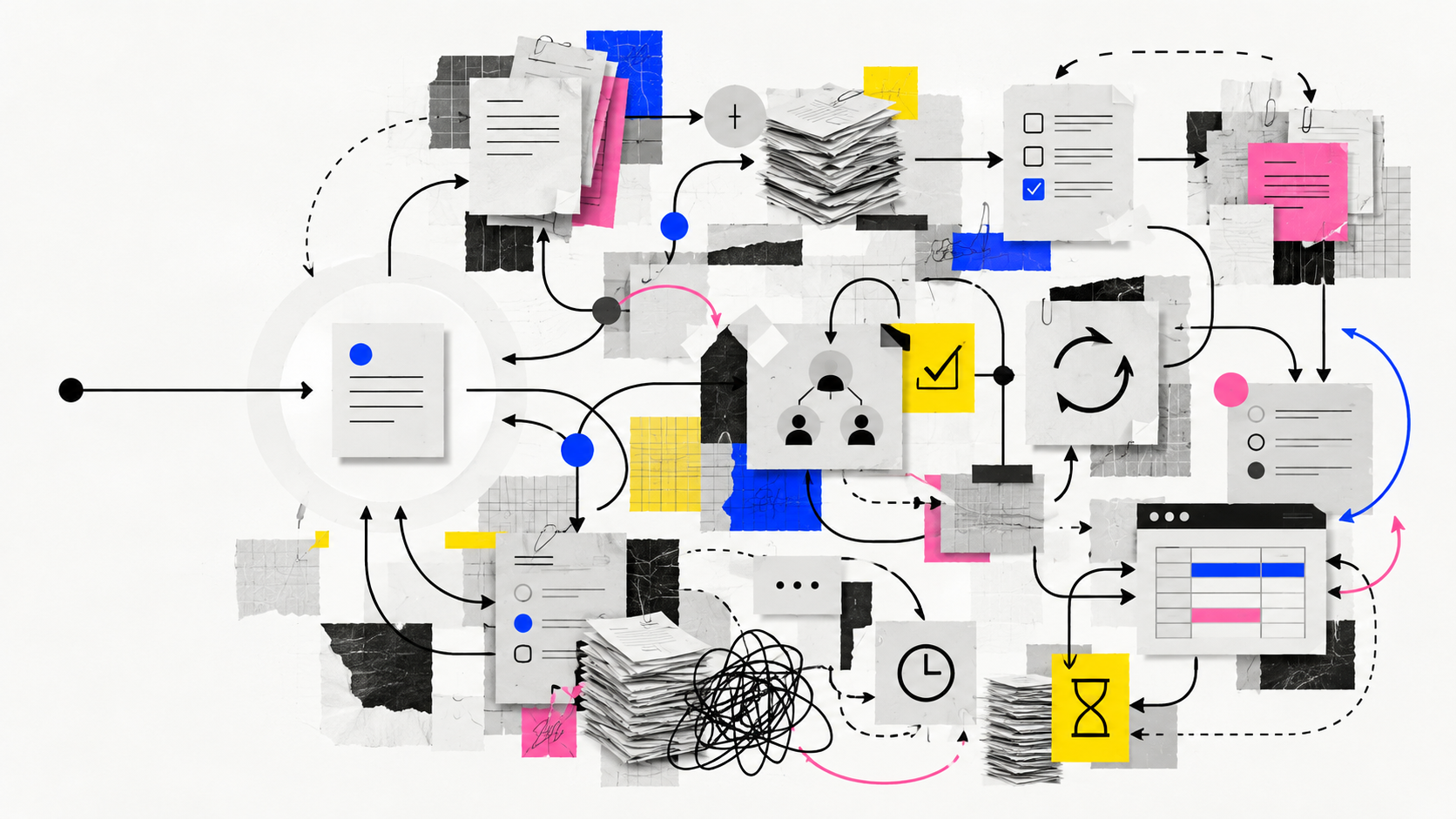
Growth doesn't have to mean more friction.
As organizations grow, some complexity is inevitable.
➕ More clients create more demands.
➕ More employees require coordination.
➕ More services introduce different workflows.
➕ More decisions require structure.
But growth and unnecessary complexity aren't the same thing.
An organization shouldn't need twice as much internal effort simply because it's handling twice as much work.
And employees shouldn't have to become experts at navigating the business just to do their jobs. The operating model needs to evolve as the organization grows.
That means periodically questioning not only whether the work is getting done, but how much effort it takes to get there.
A growing business needs more capability. It doesn't necessarily need more complexity.
The Best Process Is Often the One Nobody Notices.
Nobody celebrates that they didn't have to send a follow-up email.
Nobody talks about the approval that didn't require a meeting.
Nobody notices the information they didn't have to enter twice.
Nobody marvels at how easily a project moved from one team to another.
They just work.
A client makes a request.
✔️ The right person knows what to do.
✔️ The information is already available.
✔️ Decisions happen without unnecessary delays.
The work moves forward. And nobody has to spend half the morning figuring out how to make it happen.
That's what an effective operating model looks like.
Not more tools. Not more rules. Not more people coordinating the same work.
Less effort spent navigating the business. More effort spent moving it forward.